Load guide · IBC Table 1607.1
What Live Load Rating Does a Warehouse Mezzanine Need?
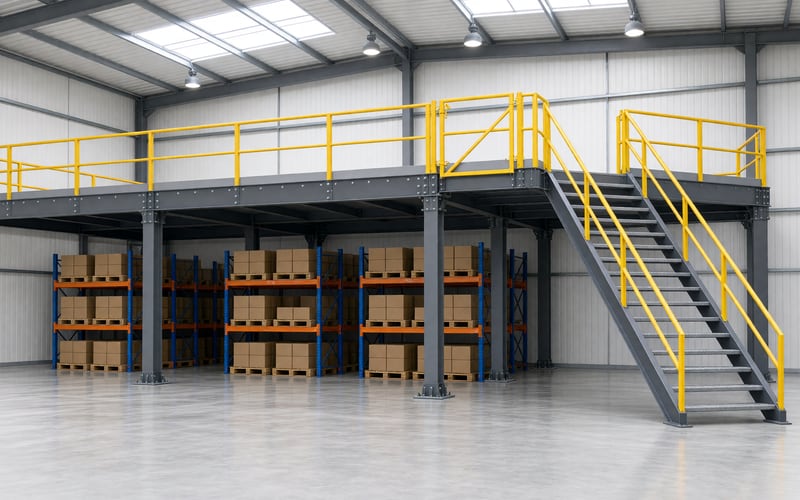
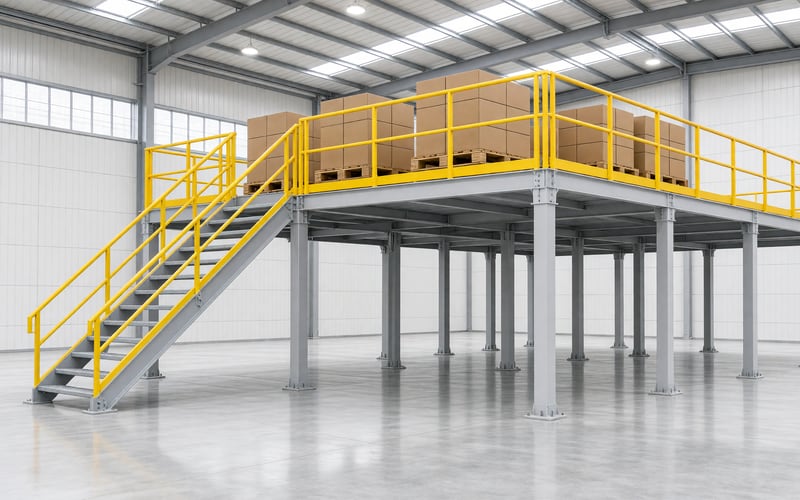
A storage mezzanine needs at least the IBC minimum for its use. The code sets 125 psf for light storage and 250 psf for heavy storage. Your engineer sets the final rating from what you will store.
What Load Rating Does a Warehouse Storage Mezzanine Need?
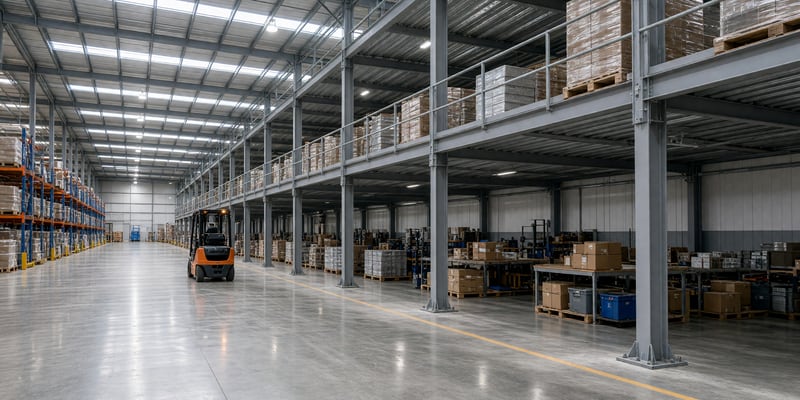
At least 125 psf for light storage and 250 psf for heavy storage. IBC Table 1607.1 sets those minimums for storage warehouses. It adds that the floor "shall be designed for heavier loads if required for anticipated storage." So the table is a floor, not a target. Dense goods can call for a higher number.
Fort Worth builds to the 2021 International Building Code, with local amendments. We size your deck to what you will store, and the engineer confirms it. See warehouse mezzanines in Fort Worth for the storage layouts we build.
What Does the Building Code Set as the Minimum Load?
The minimum depends on the use, not on the word "mezzanine." IBC Table 1607.1 has no separate row for mezzanines, so the deck takes the load of its use. Section 1607.3 says design live loads "shall be the maximum loads expected by the intended use or occupancy." They can never be less than the table values.
| Use on the deck | Minimum uniform live load |
|---|---|
| Offices | 50 psf |
| Office corridors above the first floor | 80 psf |
| Catwalks for maintenance and service access | 40 psf, plus a 300 lb concentrated load |
| Stairs and exits | 100 psf |
| Manufacturing, light or heavy | 125 psf or 250 psf |
| Storage warehouses, light or heavy | 125 psf or 250 psf, more if the goods require it |
| Wholesale stores, all floors | 125 psf |
If one deck holds two uses, each area takes its own value. A storage zone and an office zone can be rated differently.
Why Are Storage Decks Commonly Rated 125 or 250 psf?
Because those are the two storage tiers in IBC Table 1607.1. Light storage starts at 125 psf and heavy storage at 250 psf. The table also says the floor must carry heavier loads if the stored goods require it. So the two tiers are starting points, not limits.
Heavier decks can be built when the goods call for it. A higher rating takes heavier steel and stronger footings, so it adds cost. So we match the rating to your goods, not to the biggest number.
Do Pallet Jacks, Carts and Conveyors Change the Rating?
Yes, they can. A uniform rating in psf spreads the load over the whole floor. Wheels and legs press on small spots instead. Point loads such as pallet jacks and conveyor legs get their own check. So tell us about every rolling load and machine that will use the deck.
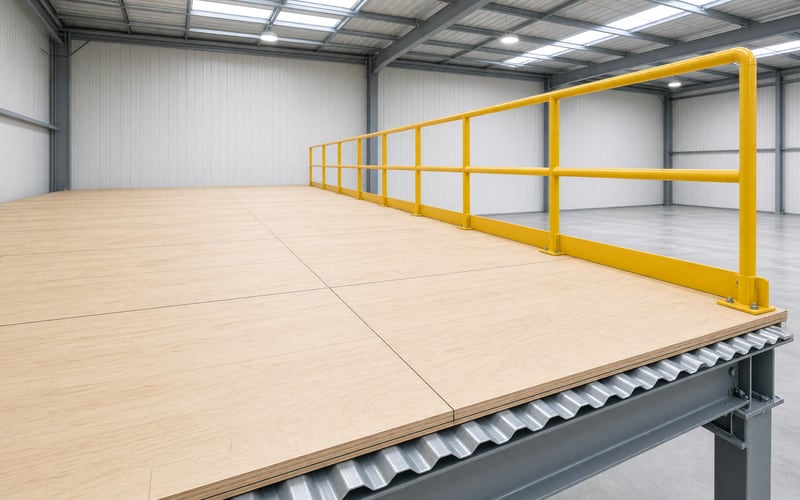
The deck surface matters too. Resin board gives carts a smooth floor, and grating lets light and air through. Compare surfaces on our mezzanine decking page.
- What you store, and what a full pallet or bin weighs.
- How goods move on the deck: by hand, cart or pallet jack.
- Any conveyor, lift or machine that stands on the deck.
- Whether the use may change later, for example from offices to storage.
How Does the Load Rating Change the Framing?
A higher rating narrows the framing choices and the spans between columns. Light C-section framing suits lighter decks. Heavier decks call for bar joists or full beam framing. Spans depend on the framing, so we size it to your column grid. Fewer columns mean deeper steel, and more columns mean lighter steel. We choose the framing after the rating is set.
Bar joist framing also leaves room for lights, sprinklers and ducts. Compare framing and decks on our mezzanine options page.
Does an Office on the Deck Need the Same Rating?
Not by the code minimum, but plan for change. IBC Table 1607.1 lists 50 psf for offices and 80 psf for office corridors above the first floor. A storage deck starts at 125 psf. If an office area may become storage later, ask us to rate it for storage now. Section 106.3 makes it unlawful to load a floor beyond what the code permits.
The stairs that serve the deck carry 100 psf in the same table.
Why Do Floors Over 50 psf Need Load Signs?
Because the building code requires them before you can use the space. IBC Section 106.1 covers each floor or portion "designed for live loads exceeding 50 psf." The owner or agent posts the design loads "using durable signs." Section 106.2 says no certificate of occupancy is issued until those signs are installed.
Storage decks start at 125 psf, so every storage mezzanine needs them. Read the code rule behind load signs.
Who Sets the Final Load Rating?
A professional engineer does, on stamped drawings the city reviews. We gather the loads, the engineer sizes the steel, and Fort Worth's plan review checks the drawings. The engineer also checks the slab and soil under each column footing. We coordinate the engineered drawings and the permit submission for you. Then you buy the mezzanine through us and our crew installs it.
See our Fort Worth permits and code page for the filing steps.
Load Rating Questions, Answered
What load rating do Fort Worth warehouse mezzanines use?
IBC Table 1607.1 sets 125 psf for light storage warehouses and 250 psf for heavy storage. Those are minimums, and heavier goods need a higher rating. We size each Fort Worth deck to what it will store.
Source: IBC Table 1607.1
Is there a mezzanine row in the load table Fort Worth uses?
No. IBC Table 1607.1 has no separate row for mezzanines. The deck takes the live load of its use. That is 50 psf for offices or 125 psf for light storage.
Source: IBC Table 1607.1
Does my Fort Worth mezzanine need load signs?
Yes, if it is designed for more than 50 psf, and every storage deck is. IBC Section 106.1 requires durable signs, and Section 106.2 holds the certificate of occupancy until they are installed.
Source: IBC 106.1 and 106.2
Sources, read November 2026: 2021 IBC Table 1607.1, via UpCodes (Texas) · 2021 IBC Sections 105 and 106, via UpCodes (Texas) · City of Fort Worth, Building & Energy Codes