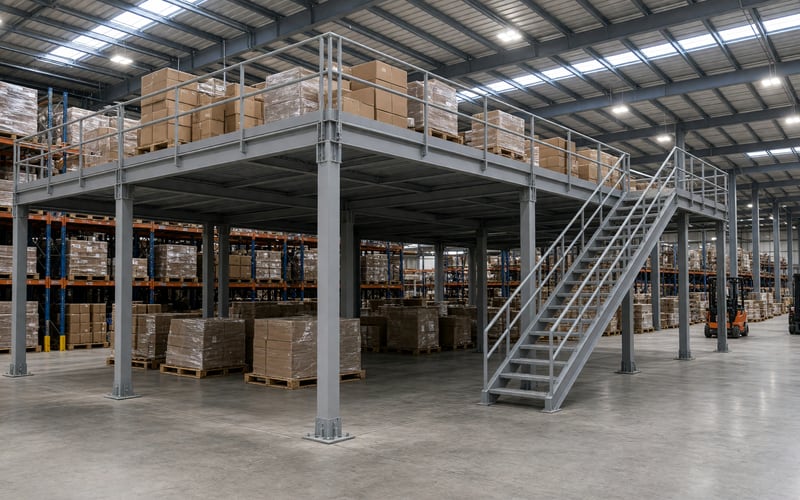
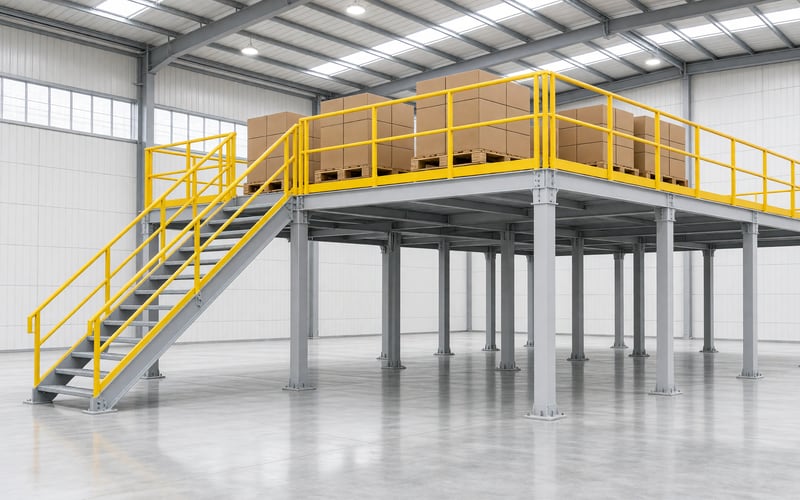
Code guide · Existing mezzanines
Bought a Building With an Old Mezzanine? How Its Load Rating Is Found
From its records if they still exist, and from an engineer's assessment if they do not. A deck with no load sign can still be rated, and the code Fort Worth adopted for existing buildings says how. Once the number is known, the deck can keep working as it is, be upgraded, or be moved.
How Is an Existing Mezzanine's Load Rating Found?
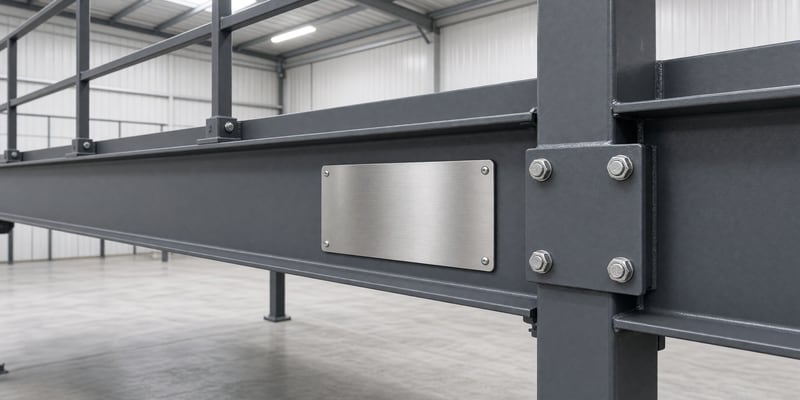
Start with the paperwork, and if there is none, an engineer works the rating out from the steel itself. Look for a load sign on the deck, the original drawings and the permit record, because the design load should appear in them. Where nothing can be found, the engineer works under IBC 1708.1, which requires "an engineering assessment" when there is "a reasonable doubt as to the stability or load-bearing capacity" of a structure "for the expected loads."
That assessment uses "either a structural analysis or an in-situ load test, or both." For how a new deck's rating is set, read mezzanine load ratings.
What Paperwork Shows a Mezzanine's Load Rating?
Three records can show it: the load sign, the construction drawings and the permit file. IBC 106.1 has owners post the design live load on "durable signs" for floors designed for more than 50 psf in commercial and industrial buildings. Today's code also puts the number on the drawings: IBC 1603.1.1 says "The uniformly distributed, concentrated and impact floor live load used in the design shall be indicated for floor areas."
Ask the seller or landlord for the drawings, the permit record and any engineer's letter about the deck. Read the code rule behind load signs for what a sign must show.
How Does an Engineer Rate a Mezzanine With No Drawings?
By measuring what is there and running the numbers, a structural analysis. IBC 1708.1 says the analysis "shall be based on actual material properties and other as-built conditions that affect stability or load-bearing capacity," and follows the design standard that applies. In practice that means the beam and column sizes, the spans, the connections, the deck and the base plates as built. Where stored goods hide parts of the frame, the engineer may ask for them to be cleared for the visit.
The result is a capacity in pounds per square foot for each area of the deck, plus any point-load limits. The engineer compares it with what you want to store, using IBC Table 1607.1: 125 psf for light storage, 250 psf for heavy storage and 50 psf for offices.
What Is a Mezzanine Floor Load Test?
A load test puts measured weight on part of the deck and watches how the structure responds, under an engineer's supervision. IBC 1708.2 says in-situ load tests "shall be supervised by a registered design professional," and that the test "shall simulate the applicable loading conditions specified in Chapter 16." Where a referenced material standard has its own test procedure, that procedure applies (1708.2.1).
The Existing Building Code Fort Worth adopted points to the same rule: IEBC 305.1 says load tests "shall be conducted in accordance with Section 1708." Whether to test, analyze or do both is the engineer's call.
Can an Old Mezzanine Keep Its Old Rating?
Often, as long as its use adds no load. IEBC 304.1 lets existing members be checked against "live loads approved prior to the addition or alteration" when the work "does not result in increased design live load." If that approved load is lower than today's IBC table, the area "shall be posted with placards of approved design indicating the approved live load."
IEBC 302.3 also lets materials installed under the approvals of their day "remain in use unless determined by the code official to be unsafe." So an older deck used as it always was can stay in service at its approved load, with its limit posted.
| Your plan | What the code asks | Section |
|---|---|---|
| Keep the same use and load | Previously approved load may stand; placards if below today's table | IEBC 304.1 |
| Store heavier goods | Today's IBC live loads for the members carrying them | IEBC 304.1, 506.5.1 |
| Add bays, decking or equipment | Members whose load rises more than 5 percent are brought up to today's loads | IEBC 503.3 |
| Capacity unknown | Structural analysis, load test, or both | IBC 1708.1 |
What Changes When You Store Heavier Goods on It?
The members carrying the heavier load must meet today's IBC live loads for that use. IEBC 304.1 says that where work "results in increased design live load, the live load required by Section 1607" of the IBC applies. Where the use of the space changes, IEBC 506.5.1 asks the same of members carrying load from the new use, unless their demand-capacity ratio goes up by no more than 5 percent.
Moving from light storage at 125 psf to heavy storage at 250 psf doubles the design live load. If the old steel cannot carry it, the engineer specifies what to add, and new members follow the IBC for new buildings (IEBC 302.4.1). The same check applies before a conveyor, a machine or a modular office goes up on the deck.
Do an Old Mezzanine's Guardrail and Stairs Meet Today's Rules?
Check them against OSHA's current numbers, because those apply to the employees who use the deck now. OSHA 1910.29(b)(1) sets the top rail of guardrail at 42 inches, plus or minus 3, above the walking surface. For stair rails, the rule depends on when they went in: rails installed before January 17, 2017 must be at least 30 inches high at the tread nose, and rails installed on or after that date at least 42 inches (1910.29(f)(1)(ii)).
Older decks may lack toeboards, midrails or a self-closing gate at the stair opening. We supply and install new guardrail, stairs and gates to today's numbers; see stairs, railings and gates.
What Can Be Done With an Old Mezzanine Once It Is Rated?
Use it as rated, or upgrade, extend, move or remove it, and we supply and install each of those jobs. The engineer's numbers set the scope, and the work goes through a Fort Worth permit like any new deck, because IBC 105.1 covers anyone who intends to "construct, enlarge, alter, repair, move, demolish" a structure.
- Reinforce: add the beams, columns or bracing the engineer specifies.
- Re-deck: a new surface for carts or heavier goods, after the frame is checked for its added dead load.
- Extend: add bays, within one-third of the room under IBC 505.2.1.
- Re-sign: durable load signs for the confirmed rating (IBC 106.1).
- Move or remove: take it down for a new layout or another building.
See mezzanine relocation, expansion and removal for moves and added bays, and mezzanine decking for new deck surfaces.
What Should You Send Us About an Old Mezzanine?
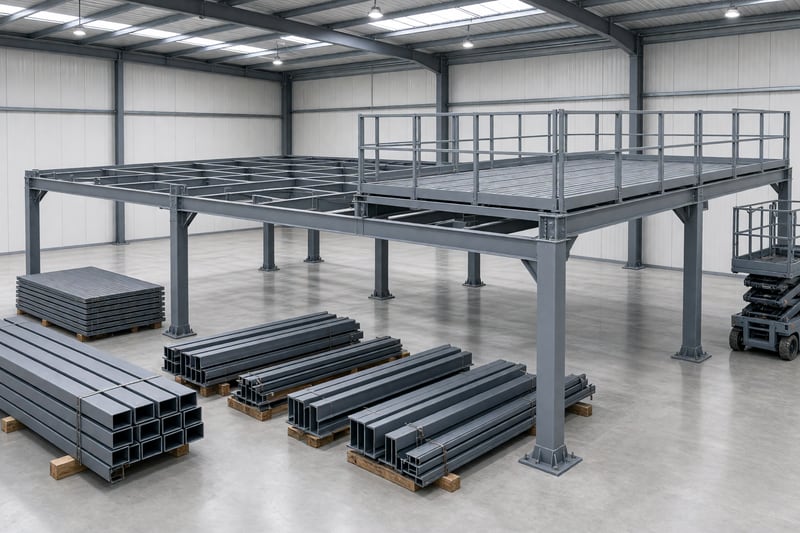
Photos, rough measurements and any papers that came with the building. The engineer can rate the deck faster from records and clear photos than from a blank page, and the same facts tell us which upgrade work to quote. Send what you have; missing items are fine.
- Photos of the frame, the columns at the floor, the base plates and the deck surface.
- The deck's size and its height above the floor.
- Any load sign, drawings, permit record or engineer's letter.
- What you want to store up there, and how it gets up and down.
- Any plan to extend, move or remove the deck.
Existing Mezzanine Questions, Answered
Who can rate an existing mezzanine in Fort Worth?
A registered design professional, such as a structural engineer. IBC 1708.2 says load tests "shall be supervised by a registered design professional," and the analysis behind a rating follows the applicable design standard (1708.1). We quote the upgrade work from the engineer's numbers.
Source: IBC 1708.1, 1708.2
Can I keep using an old mezzanine that has no load sign?
Find its approved load first. If the use stays the same, IEBC 304.1 lets the deck keep a previously approved load, with placards where that load is below today's table. If nobody can show what the load was, an engineer assesses the deck under IBC 1708.1.
Source: IEBC 304.1; IBC 1708.1
Can an old office mezzanine in Fort Worth be used for storage?
Only after its capacity is checked for storage. IBC Table 1607.1 sets 50 psf for offices but 125 psf for light storage, so a deck rated for offices may need reinforcing first. IEBC 506.5.1 applies today's IBC live loads to the members that carry a new use.
Source: IBC Table 1607.1; IEBC 506.5.1
Does reinforcing an old mezzanine need a permit in Fort Worth?
Yes, plan on one. IBC 105.1 requires a permit to construct, enlarge, alter, repair, move or demolish a structure, and Fort Worth takes commercial applications on Accela Citizen Access.
Source: IBC 105.1; City of Fort Worth Commercial Remodel SOP
Sources, read November 2026: Fort Worth Building Code 2021, Chapter 17, via UpCodes · Fort Worth Building Code 2021, Chapter 16, via UpCodes · Fort Worth Existing Building Code 2021, Chapter 3, via UpCodes · Fort Worth Existing Building Code 2021, Chapter 5, via UpCodes · 2021 IBC Table 1607.1, via UpCodes (Texas) · 2021 IBC Sections 105 and 106, via UpCodes (Texas) · City of Fort Worth, Building & Energy Codes · City of Fort Worth, Commercial Remodel SOP (2020)