OSHA guide · 1910.29
OSHA Mezzanine Guardrail Rules: Height, Strength and Toeboards
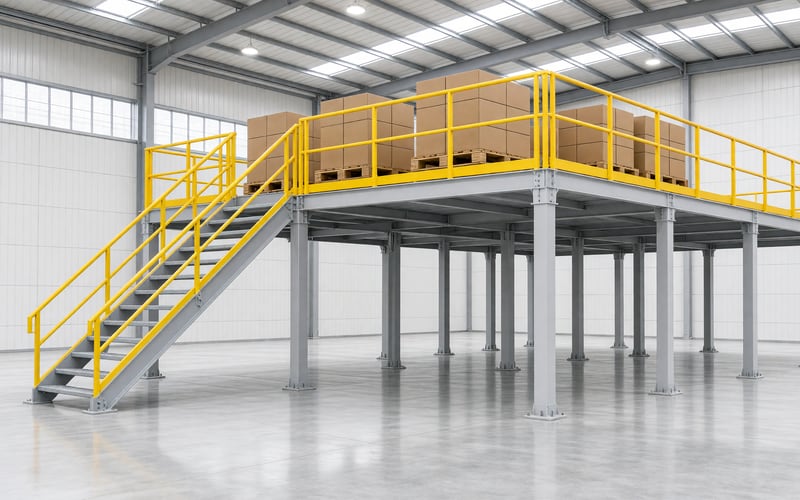
OSHA requires fall protection, usually a guardrail, at every open mezzanine edge 4 feet or more above the floor. Its top rail sits 42 inches above the deck, plus or minus 3 inches, and must withstand 200 pounds.
Which OSHA Rule Requires Guardrails on a Mezzanine?
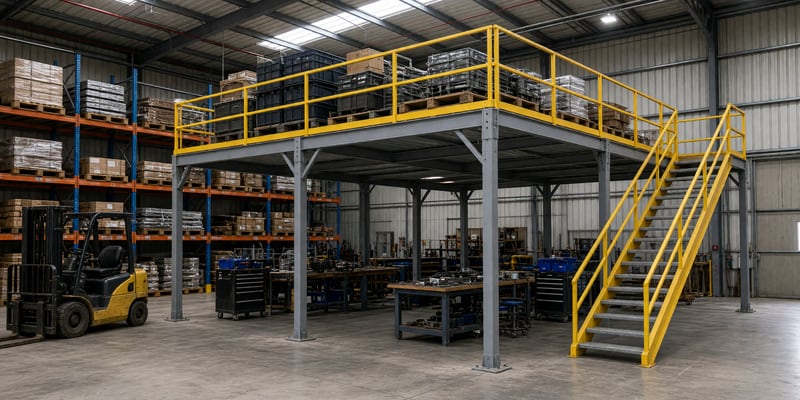
OSHA 1910.28(b)(1)(i) is the rule. It covers any open side or edge 4 feet or more above a lower level. Each employee there must be protected by a guardrail system, a safety net system or a personal fall protection system. On a mezzanine, guardrails are the usual choice, because people work near the edges all day. See mezzanine stairs, railings and gates in Fort Worth.
OSHA 1910.21 defines a guardrail system as "a barrier erected along an unprotected or exposed side, edge, or other area of a walking-working surface to prevent employees from falling to a lower level." IBC 505.2 requires at least 7 feet of clear height below a mezzanine. So every open deck edge sits above OSHA's 4-foot trigger.
How High Does a Mezzanine Guardrail Have to Be?
The top rail sits 42 inches above the deck, plus or minus 3 inches. OSHA 1910.29(b)(1) sets the height at "42 inches (107 cm), plus or minus 3 inches (8 cm), above the walking-working surface." That gives a band of 39 to 45 inches. We set rails at 42 inches, so normal tolerances stay inside the band.
Measure from the walking surface, not from the steel. A resin board or plate deck raises the surface a little. We check the rail height from the finished deck before the area goes into use.
Does a Mezzanine Guardrail Need a Midrail?
Yes, unless balusters, screens or other members fill the space below the top rail. OSHA 1910.29(b)(2)(i) says midrails "are installed at a height midway between the top edge of the guardrail system and the walking-working surface." On a 42-inch rail, that puts the midrail about 21 inches up. The other options have an opening limit instead of a set height.
- Midrail: halfway between the top rail and the deck, per 1910.29(b)(2)(i).
- Balusters: vertical members "no more than 19 inches (48 cm) apart," per 1910.29(b)(2)(iii).
- Screens or other members: openings "not more than 19 inches (48 cm) wide," per 1910.29(b)(2)(iv).
On a storage deck, a full infill panel also keeps small cartons from sliding off the edge. We pick the infill with you, based on what you store.
How Strong Does a Mezzanine Guardrail Have to Be?
The top rail must withstand at least 200 pounds pushed down or out. OSHA 1910.29(b)(3) sets "a force of at least 200 pounds (890 N) applied in a downward or outward direction." Under that load, 1910.29(b)(4) says the top rail "must not deflect to a height of less than 39 inches (99 cm)." Midrails must withstand "a force of at least 150 pounds (667 N) applied in any downward or outward direction," per 1910.29(b)(5).
| Part | Rule | Section |
|---|---|---|
| Top rail height | 42 inches, plus or minus 3 inches | 1910.29(b)(1) |
| Top rail strength | At least 200 pounds, down or out | 1910.29(b)(3) |
| Top rail under that load | Not below 39 inches | 1910.29(b)(4) |
| Midrail position | Halfway between top rail and deck | 1910.29(b)(2)(i) |
| Midrail strength | At least 150 pounds, down or out | 1910.29(b)(5) |
| Balusters or other openings | No more than 19 inches | 1910.29(b)(2)(iii) and (iv) |
| Toeboard | At least 3.5 inches tall, withstands 50 pounds | 1910.29(k)(1)(ii) and (vi) |
The posts and the deck edge they bolt to carry that force too. We size them as part of the rail, not as an add-on.
How Tall Does a Mezzanine Toeboard Have to Be?
At least 3.5 inches tall. OSHA 1910.29(k)(1)(ii) sets a "minimum vertical height of 3.5 inches (9 cm)." Section 1910.29(k)(1)(vi) says a toeboard must withstand "a force of at least 50 pounds (222 N)." A toeboard stops tools, parts and cartons from sliding off the deck onto people below. That matters most over pick aisles and work areas.
We plan kickplates with landings, stairs, rails and gates as one layout. They go along each edge where people work below.
Do the Stairs and Ladders Need Rails Too?
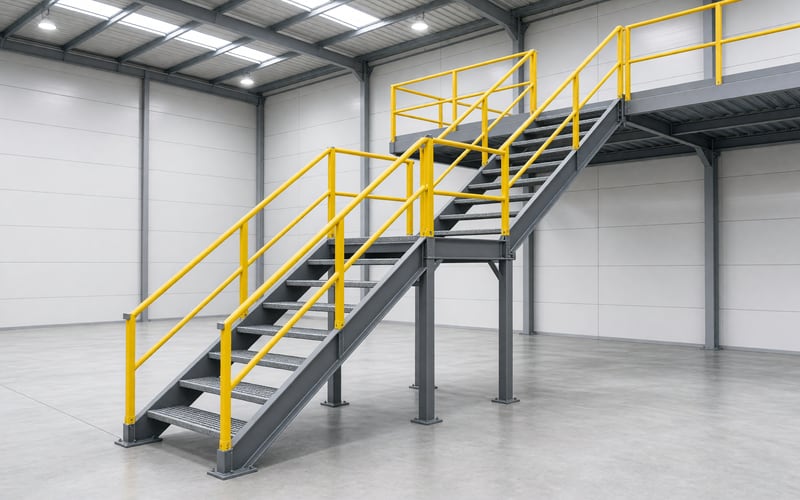
Yes. OSHA 1910.28(b)(11)(ii) says each flight with at least 3 treads and at least 4 risers "is equipped with stair rail systems and handrails." Stair rails installed on or after January 17, 2017 stand "not less than 42 inches (107 cm)" high, per 1910.29(f)(1)(ii)(B). Handrails sit "not less than 30 inches (76 cm) and not more than 38 inches (97 cm)" up, per 1910.29(f)(1)(i).
Ladders have a rail rule too. On through or side-step ladders, 1910.23(d)(4) says the side rails "extend at least 42 inches (1.1 m) above the top of the access level or landing platform served by the ladder." Our guide to mezzanine stair requirements covers angle, rise and tread.
What Goes in the Openings for Pallets and Ladders?
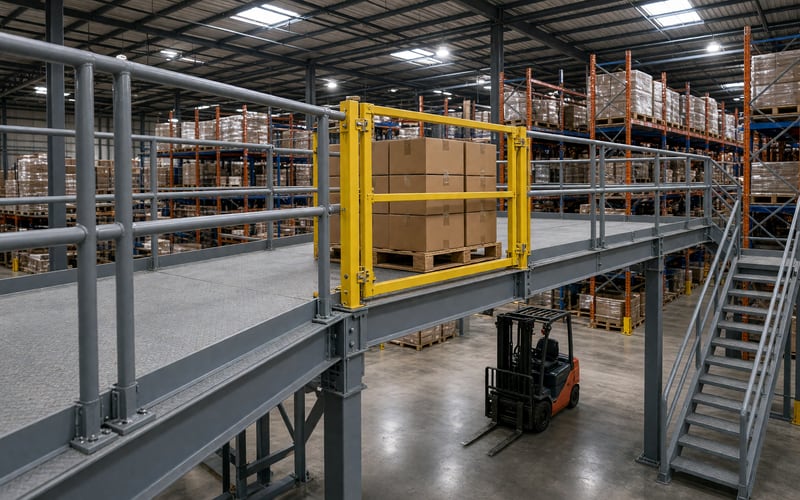
A gate, chains or an offset rail, never a plain gap. At a pallet drop, OSHA 1910.29(b)(10) lets the employer use chains or gates instead of a removable rail section. They must "provide a level of safety equivalent to guardrails." Around access openings such as a ladderway, 1910.29(b)(13) calls for "a self-closing gate that slides or swings away from the hole." A rail offset that keeps people from walking or falling in also meets that rule.
Our guide to pallet drop zone gates compares the gate styles.
Do IBC Guard Rules Apply to a Fort Worth Mezzanine Too?
Yes. Fort Worth has adopted the 2021 International Building Code, and each code has locally adopted amendments. The IBC has its own guard rules, and plan review checks your drawings against them. OSHA rules protect employees. The building code also applies to the mezzanine itself. We design to the IBC and OSHA, and the stricter rule wins at each edge.
Equipment platforms are covered too. IBC 505.3.3 says they "shall have guards where required by Section 1015.2." See Fort Worth mezzanine permits and code for the filing steps.
Mezzanine Guardrail Questions, Answered
How high must a mezzanine guardrail be in Fort Worth?
OSHA 1910.29(b)(1) sets the top rail at 42 inches, plus or minus 3 inches, above the deck. Fort Worth builds to the 2021 IBC with local amendments, and the IBC has its own guard rules. We check both and build to the stricter one.
Source: OSHA 29 CFR 1910.29(b)(1)
Does a low platform in my Fort Worth plant need a guardrail?
OSHA 1910.28(b)(1)(i) requires fall protection at an open side or edge 4 feet or more above a lower level. A guardrail is one option. Below that height, that paragraph does not apply, but the IBC guard rules may. We check both for your layout.
Source: OSHA 29 CFR 1910.28(b)(1)
Can a chain close a pallet drop on a Fort Worth mezzanine?
Only if it is as safe as a guardrail. OSHA 1910.29(b)(10) lets employers use chains or gates instead of a removable rail section at hoist areas. They must provide a level of safety equivalent to guardrails. We help you compare chains with pallet gates.
Source: OSHA 29 CFR 1910.29(b)(10)
Sources, read November 2026: OSHA 29 CFR 1910.21 · OSHA 29 CFR 1910.28 · OSHA 29 CFR 1910.29 · OSHA 29 CFR 1910.23 · 2021 IBC Section 505, via UpCodes (Texas) · City of Fort Worth, Building & Energy Codes