OSHA guide · Walkways
Catwalk and Crossover Bridge Rules: OSHA Rails, Stairs and Clearances
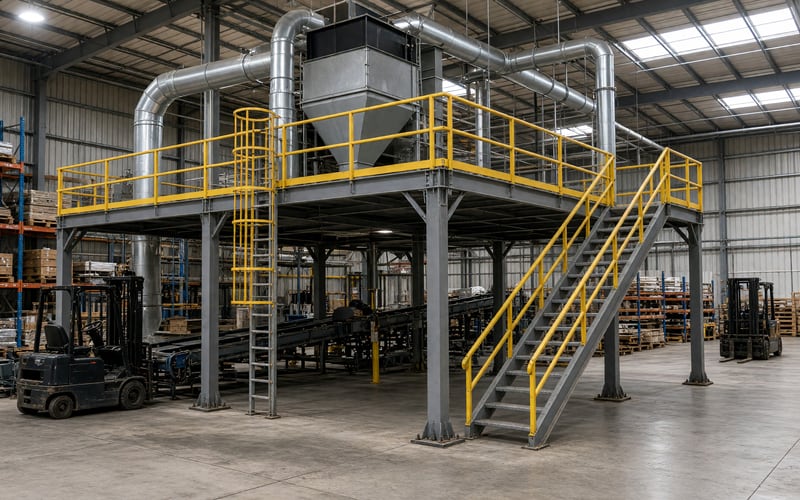
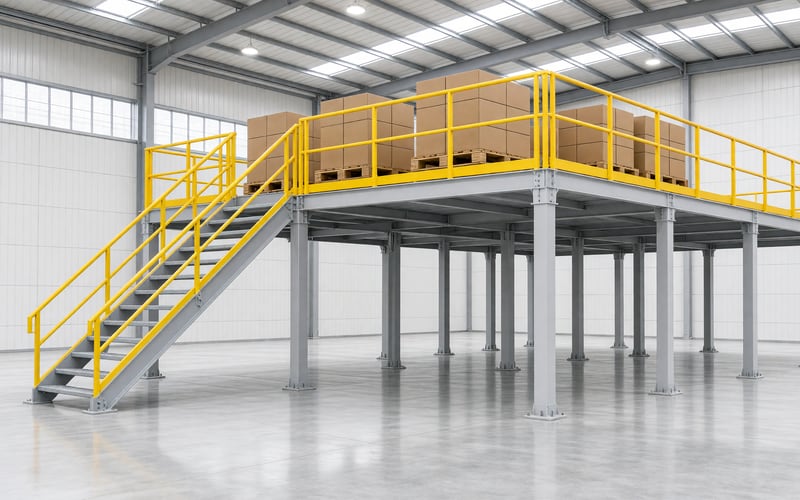
A warehouse catwalk or crossover bridge is an elevated walking-working surface, so OSHA's guardrail, stair and ladder rules apply. The IBC also lists maintenance catwalks at a 40 psf minimum live load, plus a 300-pound concentrated load.
What Counts as a Warehouse Catwalk or Crossover Bridge?
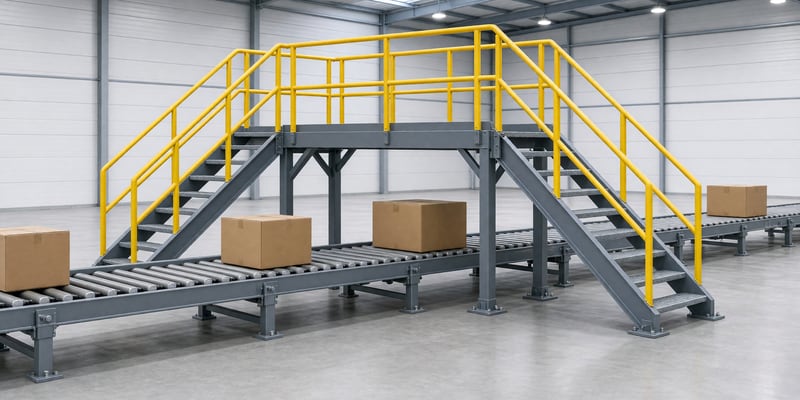
A catwalk is a narrow elevated walkway, and a crossover bridge lets people step over a conveyor or a line. OSHA treats both as elevated walking-working surfaces. It defines a platform as "a walking-working surface that is elevated above the surrounding area." Catwalks run along racks, shelving or equipment for service and picking. Crossovers span a conveyor, so no one climbs over it. See warehouse catwalk systems in Fort Worth.
When Does a Catwalk Need Guardrails?
When an open side is 4 feet or more above a lower level. OSHA 1910.28(b)(1)(i) requires a guardrail system, a safety net system or a personal fall protection system at that height. On a narrow walkway, guardrails on both open sides are the practical choice. The top rail sits "42 inches (107 cm), plus or minus 3 inches (8 cm), above the walking-working surface," per 1910.29(b)(1).
| Part | Rule | Section |
|---|---|---|
| Top rail height | 42 inches, plus or minus 3 inches | 1910.29(b)(1) |
| Top rail strength | At least 200 pounds, down or out | 1910.29(b)(3) |
| Top rail under that load | Not below 39 inches | 1910.29(b)(4) |
| Midrail | Halfway up; at least 150 pounds, down or out | 1910.29(b)(2)(i) and (b)(5) |
| Balusters or other openings | No more than 19 inches | 1910.29(b)(2)(iii) and (iv) |
| Toeboard | At least 3.5 inches tall, withstands 50 pounds | 1910.29(k)(1)(ii) and (vi) |
A crossover over a conveyor has people working beside and below it. Toeboards keep tools and parts on the deck. Our OSHA guardrail guide explains each part of the rail.
What Load Does a Warehouse Catwalk Have to Carry?
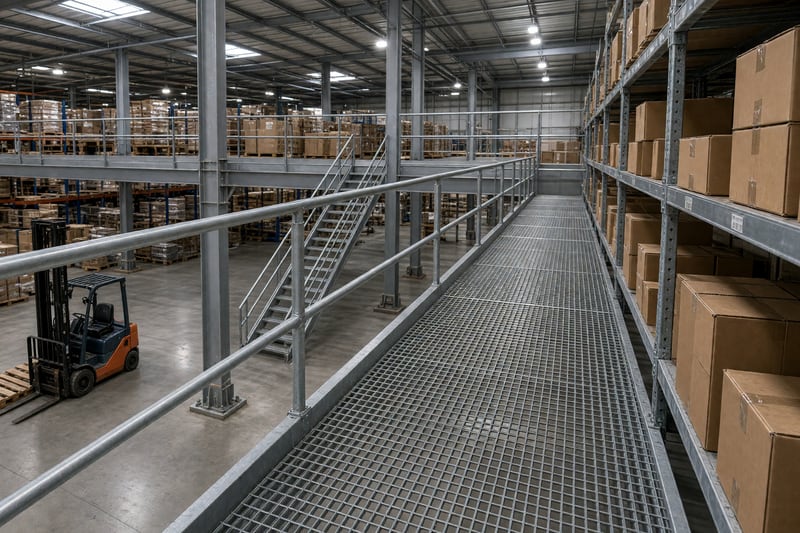
IBC Table 1607.1 sets 40 psf for catwalks used for maintenance and service access, plus a 300-pound concentrated load. That is a minimum. IBC 1607.3 says design loads "shall be the maximum loads expected by the intended use or occupancy." A catwalk where people also stage parts or stock may need a higher rating. Your engineer sets the final number.
A walkway that only serves an equipment platform can be part of that platform. The IBC defines an equipment platform to include "the associated elevated walkways, stairways, alternating tread devices and ladders necessary to access the platform." Read equipment platform vs mezzanine for what that changes.
What Stair Rules Apply to a Crossover Bridge?
The same OSHA 1910.25 rules as any other stair. Standard stairs run at "angles between 30 to 50 degrees from the horizontal," per 1910.25(c)(1). Risers are 9.5 inches tall at most, and treads are 9.5 inches deep at least. The minimum width is 22 inches between vertical barriers. Landings are at least the width of the stair and at least 30 inches deep.
- Headroom: at least 6 feet, 8 inches above any tread, per 1910.25(b)(2).
- Strength: five times the normal anticipated live load, and at least 1,000 pounds at any point, per 1910.25(b)(6).
- Rails: stair rail systems and handrails on any flight with at least 3 treads and 4 risers, per 1910.28(b)(11)(ii).
- Rail heights: stair rails at least 42 inches, if installed on or after January 17, 2017; handrails 30 to 38 inches.
- Landing edges 4 feet or more up: a guardrail or stair rail system, per 1910.28(b)(11)(i).
Our guide to mezzanine stair requirements covers each rule in more depth.
Can a Crossover Use Ship Stairs or a Ladder?
Yes, where floor space is tight. OSHA 1910.25(e)(1) and (f)(1) set ship stairs and alternating tread stairs at "50 to 70 degrees from the horizontal." Fixed ladders follow 1910.23. Their rungs sit 10 to 14 inches apart, center to center. Fixed ladders need at least 16 inches of clear width. Steep stairs and ladders suit service trips, not routes people use all shift.
- Side rails on through or side-step ladders: at least 42 inches above the landing, per 1910.23(d)(4).
- Fixed ladders over 24 feet installed on or after November 19, 2018: a personal fall arrest system or a ladder safety system, per 1910.28(b)(9)(i)(B).
- Ladder openings in the guardrail: a self-closing gate or an offset rail, per 1910.29(b)(13).
How High and How Wide Should a Crossover Bridge Be?
Size it for what passes under it and who walks across it. The height under a crossover comes from the tallest load on the conveyor and the tallest vehicle that drives beneath. The walkway width comes from the people, carts and tools that use it. The stairs at each end have fixed numbers. OSHA 1910.25(c)(4) sets a 22-inch minimum stair width, and 1910.25(b)(2) sets at least 6 feet, 8 inches of headroom.
We measure those heights on the site visit, before any steel is drawn. The building code may also apply to a walkway in your building, and Fort Worth plan review decides.
Can We Supply and Install the Whole Walkway?
Yes. You buy the catwalk or crossover bridge through us, and our crew installs it. That covers the deck, the stairs or ladder, the guardrails and the toeboards. One order, one crew, one point of contact. We coordinate the engineered drawings and the permit submission. Grating lets light, air and sprinkler water pass, and your plan review decides what the fire code needs. Compare walkway, deck and stair choices on our mezzanine options page.
Catwalk and Crossover Questions, Answered
Do catwalks in a Fort Worth warehouse need guardrails?
Yes, where an open side is 4 feet or more above a lower level. OSHA 1910.28(b)(1)(i) requires fall protection there, and a guardrail is the usual choice. The top rail sits at 42 inches, plus or minus 3 inches.
Source: OSHA 29 CFR 1910.28(b)(1) and 1910.29(b)(1)
What live load does a catwalk need in Fort Worth?
IBC Table 1607.1 lists catwalks for maintenance and service access at 40 psf, with a 300-pound concentrated load. If people also stage stock on it, the design load follows that heavier use. Your engineer sets the rating.
Source: IBC Table 1607.1 and Section 1607.3
Can a Fort Worth conveyor crossover use ship stairs?
Yes, where floor space is tight. OSHA 1910.25(e)(1) allows ship stairs at 50 to 70 degrees from the horizontal. Standard stairs at 30 to 50 degrees are the easier climb for routes people use all shift.
Source: OSHA 29 CFR 1910.25(c)(1) and (e)(1)
Sources, read November 2026: OSHA 29 CFR 1910.21 · OSHA 29 CFR 1910.23 · OSHA 29 CFR 1910.25 · OSHA 29 CFR 1910.28 · OSHA 29 CFR 1910.29 · 2021 IBC Table 1607.1, via UpCodes (Texas) · Fort Worth Building Code 2021, Chapter 2 definitions, via UpCodes